Choosing the Right Stone: Diamonds vs Moissanite vs Lab Diamonds
Choosing a center stone is the single biggest decision in your ring design. It sets the sparkle style, the durability profile, and most of the budget. The problem is that most advice online treats “diamond vs moissanite vs lab diamond” as a vibe check, not a decision framework. You deserve a clear, real-world comparison that makes the tradeoffs obvious.
This guide breaks down how each stone performs in daily life, how to compare price per millimeter (not just carats), and which specs matter for your priorities. We will also show you how to read lab reports, avoid common seller tricks, and choose a stone that still feels right a decade from now.
If you want a ring that feels personal and practical, this is the stone decision playbook.
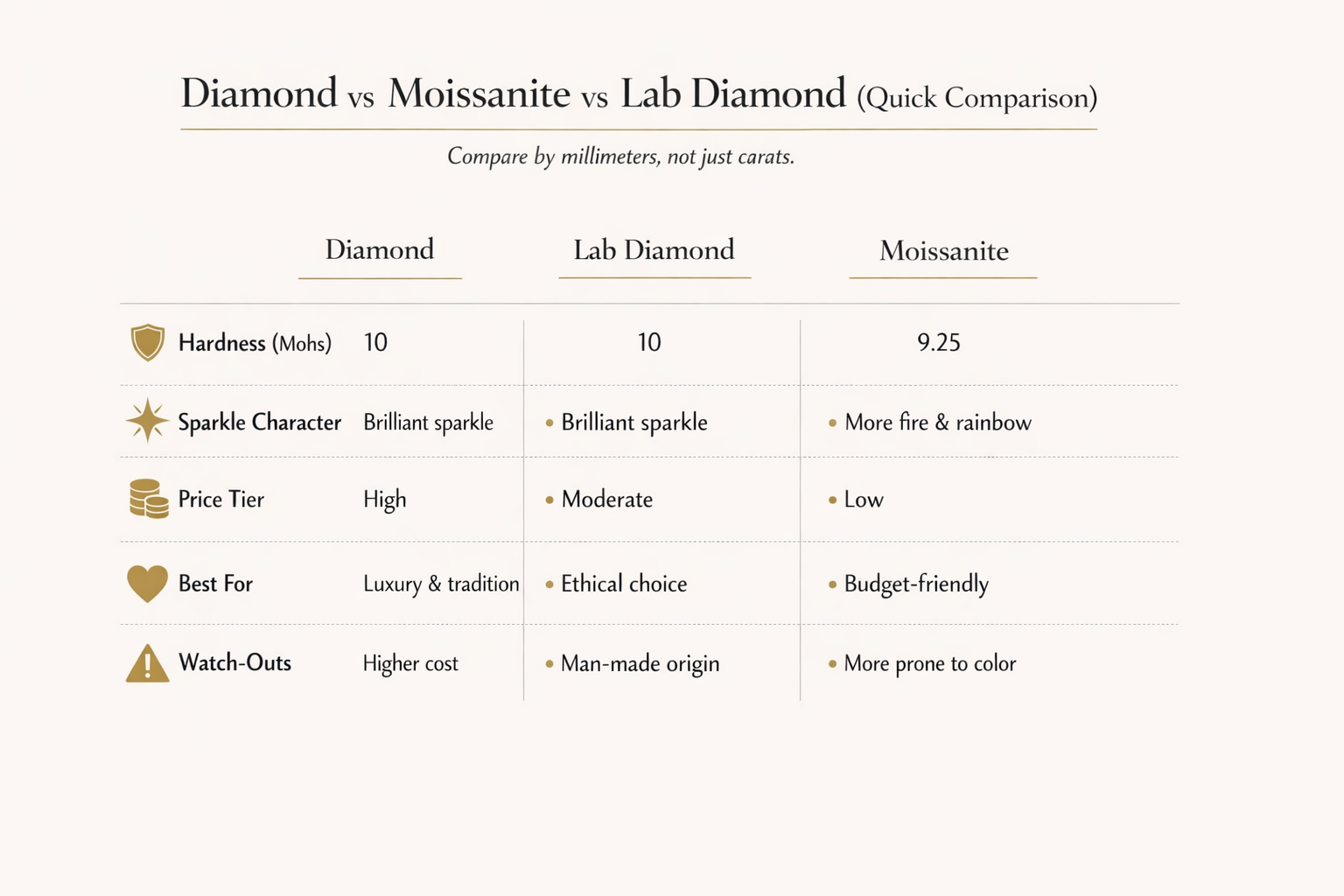
A quick, real-world comparison — use it to narrow your shortlist before you dive into specs.
Start with how the stone behaves in real life
Most comparisons fixate on sparkle, but daily life is a better filter. The three core variables are hardness (scratch resistance), toughness (how it handles impact), and maintenance (cleaning and long-term wear).
Diamond (natural or lab)
Diamond is a 10 on the Mohs hardness scale. That means it resists scratches better than any other gem. For people who wear their ring daily, this matters more than sparkle. Diamonds can still chip (especially at sharp corners), but they are the most robust choice for decades of wear.
Unique insight: because diamond is so hard, it can scratch other jewelry and even household surfaces. If you stack rings, diamond can be the abrasive in the pairing. Plan for a protective band or a small gap.
Moissanite
Moissanite is about 9.25 on the Mohs scale. It is very durable for daily wear, but it can still pick up fine surface wear over years. Its toughness is good, and it tends to handle impact well, though certain shapes with sharp tips can still be vulnerable.
Unique insight: moissanite can show more “rainbow” flashes (dispersion) than diamond. That looks stunning in some lights, but in others it can read slightly “electric.” If you want a more subdued sparkle, you might prefer a warmer moissanite or a diamond with a different cut style.
Lab diamonds
Lab diamonds are chemically and optically the same as natural diamonds. They score 10 on Mohs, and their durability is identical. In practical terms, the difference is origin (lab vs mined) and price. If daily durability is your top priority, lab and natural diamonds perform the same.
Unique insight: because lab diamonds are still diamonds, they can be graded and certified the same way. If you care about optics and long-term wear, the same cut and clarity rules apply. The origin does not change the physics.
Compare value by millimeters, not carats
Carat is a weight measurement, not a size measurement. Two stones with the same carat can look very different if they have different cut depths or shapes. A smart buyer compares millimeter dimensions and face-up area.
Example: 1.5 carat round vs 1.5 carat oval
A 1.5 ct round might face up around 7.3–7.5 mm, while a 1.5 ct oval could measure closer to 9.0 x 6.5 mm. Even at the same weight, the oval looks larger because it spreads weight lengthwise. That is why elongated shapes often feel like a “free size upgrade.”
Use price per mm as your mental model
Instead of asking “what is the biggest carat we can afford,” ask “what millimeter size fits the finger and feels balanced.” Then compare diamond, lab diamond, and moissanite options at that same mm target. This keeps your decision grounded in visuals and comfort instead of weight.
Unique insight: a slightly smaller, better-cut stone often looks brighter and larger because it returns more light. “Bigger” is not always a carat problem; it can be a cut quality problem.
Sparkle style: brilliance vs fire vs shimmer
You are not just choosing a stone. You are choosing a sparkle character. The three sparkles to know are brilliance (white light return), fire (colored flashes), and scintillation (how it twinkles as you move).
Diamonds
Diamonds tend to show balanced white brilliance with controlled fire, especially when cut to ideal proportions. A well-cut diamond has crisp, clean sparkle and strong contrast patterns, which look elegant and timeless.
Moissanite
Moissanite has higher dispersion than diamond, so it produces more colorful flashes. Some people love this “rainbow sparkle,” while others feel it looks too flashy or less like a traditional diamond. The cut style matters: round moissanite often looks closer to diamond, while certain elongated shapes show more fire.
Lab diamonds
Lab diamonds sparkle like natural diamonds because they are the same material. The difference is the market price and the origin story, not the optical behavior.
Unique insight: if you are sensitive to the “colorful disco” effect, ask to see the stone under mixed lighting (daylight + warm interior). That is where moissanite will show its character most strongly.
Origin, ethics, and the sustainability layer
Many buyers care about ethics and sustainability, but the conversation is complex. “Lab” does not automatically mean sustainable, and “natural” does not automatically mean unethical. The right choice depends on traceability and your personal comfort level.
Natural diamonds
Natural diamonds are mined. Ethical sourcing depends on the supply chain. Some buyers prioritize diamonds with detailed provenance, while others choose vintage or recycled stones to avoid new extraction.
Lab diamonds
Lab diamonds avoid mining, but they require energy to produce. The sustainability profile depends on the energy source and transparency of the producer. Ask for supplier information and certifications if this is a key priority.
Moissanite
Moissanite is typically lab-created. Its footprint can be lower than mined stones, but as with lab diamonds, energy source and transparency matter. Ask how the stone is produced and where.
Unique insight: if sustainability is central, consider a two-part approach: choose a lab or recycled stone and pair it with recycled metal. That combination often has a bigger impact than debating lab vs mined alone.
How to read lab reports without confusion
A lab report is your protection against marketing language. For diamonds and lab diamonds, you want a report from a respected lab (like GIA or IGI) that specifies the 4Cs and any treatments. For moissanite, reports are less standardized, so focus on cut quality, color grade, and transparency claims.
The 4Cs still matter (cut is king)
Cut quality affects brightness more than any other factor. A slightly lower color or clarity stone with excellent cut will outperform a higher color stone with a mediocre cut. Prioritize cut for how the stone actually looks on your hand.
Color and clarity in real-world terms
Many buyers are happy in the G–H color range and VS2–SI1 clarity range (for diamonds), especially when the stone is cut well and set in yellow or rose gold. The goal is “eye-clean,” not microscope perfection.
Unique insight: clarity matters more in step-cut shapes (emerald, asscher) because they act like mirrors. If you love step cuts, allocate more budget to clarity and cut.
Budget reality: the price curve is not linear
This is where buyers can save thousands without sacrificing looks. Prices jump at popular milestone weights (1.0, 1.5, 2.0 carats). If you drop just below those “magic numbers,” you can often save significantly while keeping a similar face-up size.
The budget ladder: diamond vs lab vs moissanite
Natural diamonds tend to be the most expensive, lab diamonds are typically far less per carat for similar visual performance, and moissanite is usually the most affordable for large sizes. The right choice depends on which value you prioritize: heritage, ethics, maximum size, or traditional diamond look.
A practical decision rule
If you care most about classic diamond optics and long-term wear, choose diamond (natural or lab) and prioritize cut. If you care most about size-for-budget, moissanite is the highest-impact option. If you want diamond optics without the mined premium, lab diamonds are the middle path.
Want to compare stones by shape and size?
Rinderr helps you compare center stone sizes, shapes, and proportions so you can choose the right look before you ever step into a showroom.
Browse ring styles and stone types on Rinderr
Shape matters: durability and design fit
The stone shape changes both aesthetics and durability. Sharp corners are more prone to chipping, while rounded shapes are more forgiving. If you choose a pointed shape, pair it with a setting that protects tips.
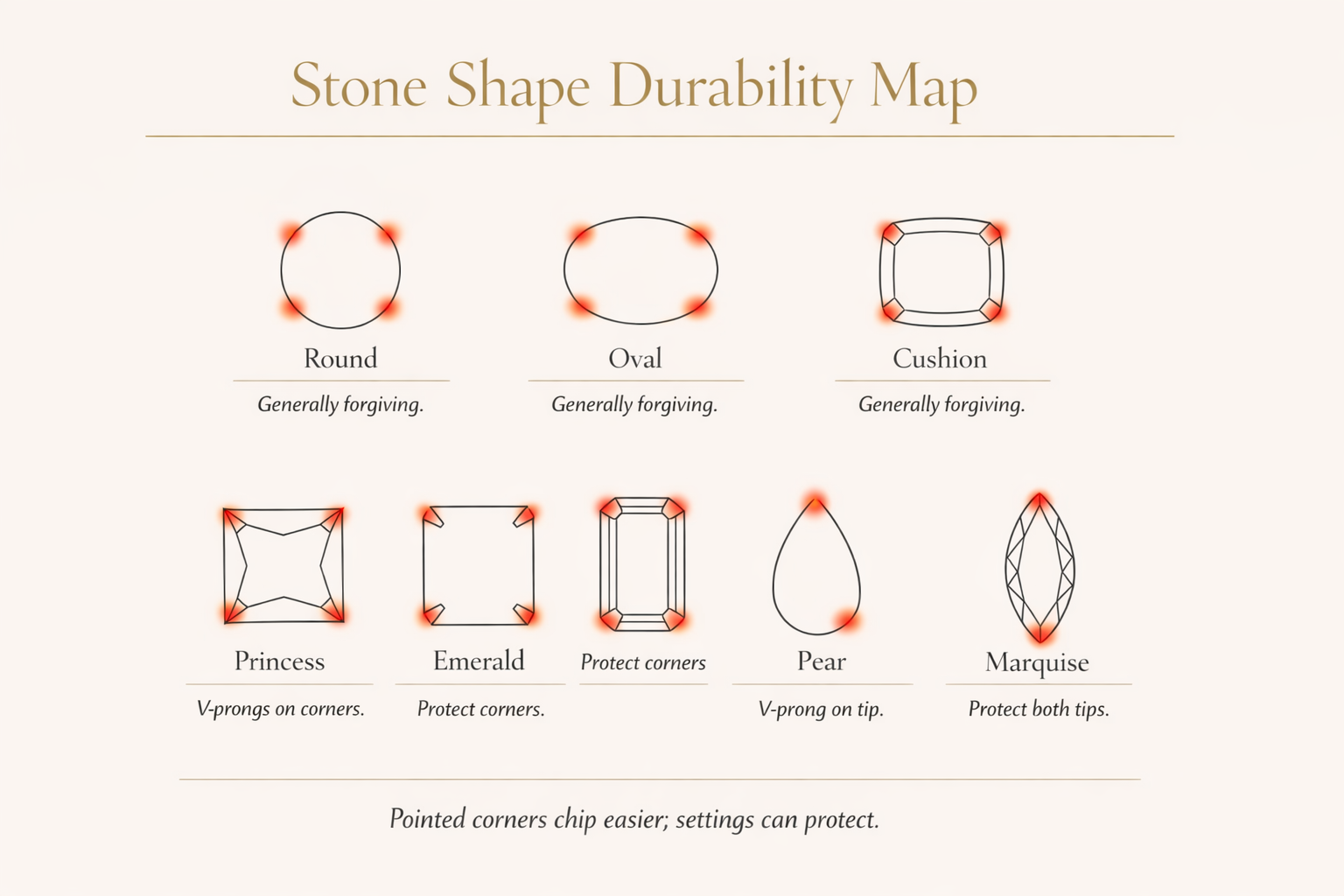
Pointed corners (princess, pear, marquise) need more protection — this map helps you choose a shape that matches your lifestyle.
Best shapes for daily wear
Round, oval, and cushion shapes tend to be the most forgiving. They are easier to protect with prongs or bezels, and they handle daily impact better. Emerald and marquise shapes can be stunning, but they need careful setting design to protect corners and points.
Setting compatibility
A low-profile bezel can make a moissanite or lab diamond feel more modern and secure. Traditional prong settings maximize light return but expose edges more. Your lifestyle should decide which tradeoff feels right.
Unique insight: if you are torn between two shapes, compare them at the same face-up mm size, not the same carat. That removes the weight bias and reveals which shape actually looks better on your hand.
Visual concepts you can ask a jeweler to sketch
Stone comparison grid: A 3x3 grid showing round, oval, and emerald cuts in diamond, lab diamond, and moissanite at the same face-up mm size. Include a note on sparkle style and price tier for each. Alt text: “diamond vs moissanite vs lab diamond size and sparkle comparison chart.”
Budget vs size curve: A simple line chart showing how price jumps at 1.0, 1.5, and 2.0 carats for natural and lab diamonds, with moissanite as a flatter line. Alt text: “engagement ring stone price curve by carat.”
Durability map: A silhouette of common shapes with color-coded tips indicating where chips typically occur, plus recommended setting protection (V-prong, bezel, double prong). Alt text: “diamond shape durability and protection map.”
Quick Takeaways
- Diamond and lab diamond are the same material; origin is the difference.
- Moissanite is durable and brilliant but has a distinct rainbow sparkle.
- Compare stones by millimeters and face-up size, not only carats.
- Cut quality impacts sparkle more than color or clarity.
- Elongated shapes look larger at the same weight.
- Ethical sourcing depends on traceability, not marketing claims.
- Set a budget by lifestyle priorities, not social expectations.
FAQs
Does moissanite look fake?
It depends on your definition of “diamond-like.” Moissanite has more colorful fire and a slightly different sparkle pattern. In many settings it reads as high-end, but if you want traditional diamond optics, a lab diamond is closer.
Are lab diamonds lower quality than natural?
No. Lab diamonds are real diamonds with the same physical properties. Quality depends on the 4Cs and cut, not origin.
Which is more sustainable: lab diamond or moissanite?
It depends on the producer’s energy source and transparency. Ask for supplier details and certifications. Pairing any lab stone with recycled metal often improves overall sustainability.
What clarity grade is “eye-clean” for an engagement ring?
Many buyers find VS2–SI1 clarity to be eye-clean in round shapes, though step cuts may need higher clarity because they show inclusions more easily.
How can I make a stone look bigger without raising the budget?
Choose an elongated shape, set it with a thinner band, or consider a slightly lower carat weight just under a milestone (like 0.95 instead of 1.0).
Related reading
Conclusion
The best stone choice is the one that fits your priorities, not someone else’s. If you want traditional diamond optics and long-term durability, natural or lab diamonds are the closest match. If you want maximum size and a vibrant sparkle character, moissanite is a strong contender. And if you want diamond performance with a more accessible price, lab diamonds are the clean middle ground.
Remember: the “right” stone is less about carat and more about how it looks and feels on your hand every day. Compare by millimeters, choose a shape that fits your lifestyle, and prioritize cut quality above the rest. Those decisions will make your ring feel intentional and beautiful for years.
If you want help narrowing your options, compare shapes and sizes side-by-side in
Rinderr's ring explorer
and build your stone shortlist before you shop. It is the fastest way to avoid regret.
Reader feedback and share prompt
If this helped, share it with someone comparing stones right now. What matters most to you in a center stone: size, sparkle style, or long-term durability?